
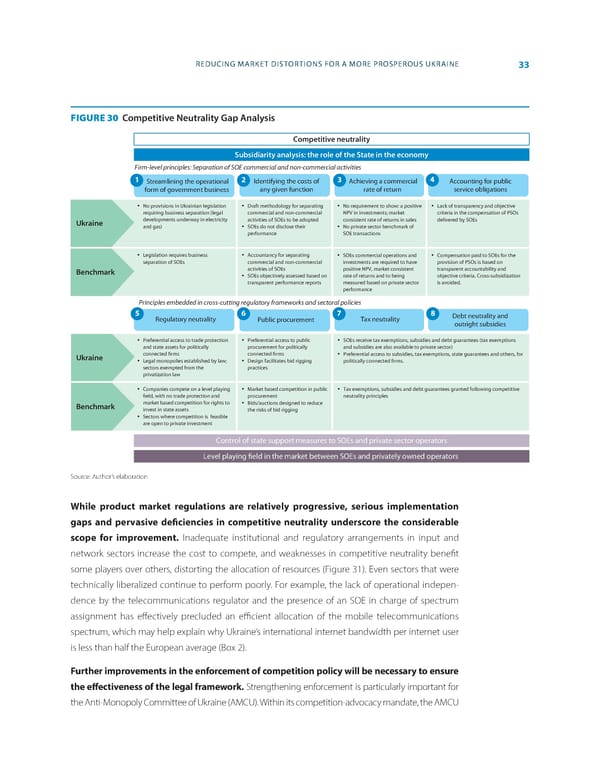
REDUCING MARKET DISTORTIONS FOR A MORE PROSPEROUS UKRAINE 33 FIGURE 30 Competitive Neutrality Gap Analysis Competitive neutrality Subsidiarity analysis: the role of the State in the economy Firm-level principles: Separation of SOE commercial and non-commercial activities 1 Streamlining the operational 2 Identifying the costs of 3 Achieving a commercial 4 Accounting for public form of government business any given function rate of return service obligations No provisions in Ukrainian legislation Draft methodology for separating No requirement to show: a positive Lack of transparency and objective requiring business separation (legal commercial and non-commercial NPV in investments; market criteria in the compensation of PSOs Ukraine developments underway in electricity activities of SOEs to be adopted consistent rate of returns in sales delivered by SOEs and gas) SOEs do not disclose their No private sector benchmark of performance SOE transactions Legislation requires business Accountancy for separating SOEs commercial operations and Compensation paid to SOEs for the separation of SOEs commercial and non-commercial investments are required to have provision of PSOs is based on Benchmark activities of SOEs positive NPV, market consistent transparent accountability and SOEs objectively assessed based on rate of returns and to being objective criteria. Cross-subsidization transparent performance reports measured based on private sector is avoided. performance Principles embedded in cross-cutting regulatory frameworks and sectoral policies 5 Regulatory neutrality 6 7 Tax neutrality 8 Debt neutrality and Public procurement outright subsidies Preferential access to trade protection Preferential access to public SOEs receive tax exemptions, subsidies and debt guarantees (tax exemptions and state assets for politically procurement for politically and subsidies are also available to private sector) Ukraine connected rms connected rms Preferential access to subsidies, tax exemptions, state guarantees and others, for Legal monopolies established by law; Design facilitates bid rigging politically connected rms. sectors exempted from the practices privatization law Companies compete on a level playing Market based competition in public Tax exemptions, subsidies and debt guarantees granted following competitive eld, with no trade protection and procurement neutrality principles Benchmark market based competition for rights to Bids/auctions designed to reduce invest in state assets the risks of bid rigging Sectors where competition is feasible are open to private investment Control of state support measures to SOEs and private sector operators Level playing eld in the market between SOEs and privately owned operators Source: Author’s elaboration While product market regulations are relatively progressive, serious implementation gaps and pervasive de昀椀ciencies in competitive neutrality underscore the considerable scope for improvement. Inadequate institutional and regulatory arrangements in input and network sectors increase the cost to compete, and weaknesses in competitive neutrality bene昀椀t some players over others, distorting the allocation of resources (Figure 31). Even sectors that were technically liberalized continue to perform poorly. For example, the lack of operational indepen- dence by the telecommunications regulator and the presence of an SOE in charge of spectrum assignment has e昀昀ectively precluded an e昀케cient allocation of the mobile telecommunications spectrum, which may help explain why Ukraine’s international internet bandwidth per internet user is less than half the European average (Box 2). Further improvements in the enforcement of competition policy will be necessary to ensure the e昀昀ectiveness of the legal framework. Strengthening enforcement is particularly important for the Anti-Monopoly Committee of Ukraine (AMCU). Within its competition-advocacy mandate, the AMCU
 World Bank Document Page 40 Page 42