
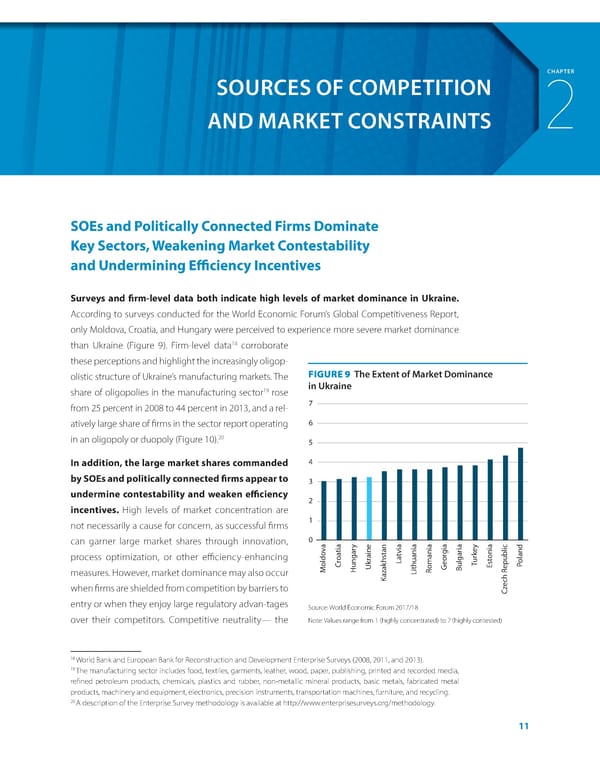
CHAPTER SOURCES OF COMPETITION AND MARKET CONSTRAINTS 2 SOEs and Politically Connected Firms Dominate Key Sectors, Weakening Market Contestability and Undermining E昀케ciency incentives Surveys and 昀椀rm-level data both indicate high levels of market dominance in Ukraine. According to surveys conducted for the World Economic Forum’s Global Competitiveness Report, only Moldova, Croatia, and Hungary were perceived to experience more severe market dominance than Ukraine (Figure 9). Firm-level data18 corroborate these perceptions and highlight the increasingly oligop- olistic structure of Ukraine’s manufacturing markets. The FIGURE 9 The Extent of Market Dominance 19 in Ukraine share of oligopolies in the manufacturing sector rose from 25 percent in 2008 to 44 percent in 2013, and a rel- 7 atively large share of 昀椀rms in the sector report operating 6 in an oligopoly or duopoly (Figure 10).20 5 in addition, the large market shares commanded 4 by SOEs and politically connected 昀椀rms appear to 3 undermine contestability and weaken e昀케ciency 2 incentives. High levels of market concentration are not necessarily a cause for concern, as successful 昀椀rms 1 can garner large market shares through innovation, 0 a y ia ia v tia via g key process optimization, or other e昀케ciency-enhancing oa aine t onia r r hstanLa eor ur oland oldoC HungarUk omaniaG BulgarT Est epublicP measures. However, market dominance may also occur M azak LithuaniaR K ech R when 昀椀rms are shielded from competition by barriers to z C entry or when they enjoy large regulatory advan-tages Source: World Economic Forum 2017/18 over their competitors. Competitive neutrality— the Note: Values range from 1 (highly concentrated) to 7 (highly contested) 18 World Bank and European Bank for Reconstruction and Development Enterprise Surveys (2008, 2011, and 2013). 19 The manufacturing sector includes food, textiles, garments, leather, wood, paper, publishing, printed and recorded media, re昀椀ned petroleum products, chemicals, plastics and rubber, non-metallic mineral products, basic metals, fabricated metal products, machinery and equipment, electronics, precision instruments, transportation machines, furniture, and recycling. 20 A description of the Enterprise Survey methodology is available at http://www.enterprisesurveys.org/methodology. 11
 World Bank Document Page 18 Page 20