
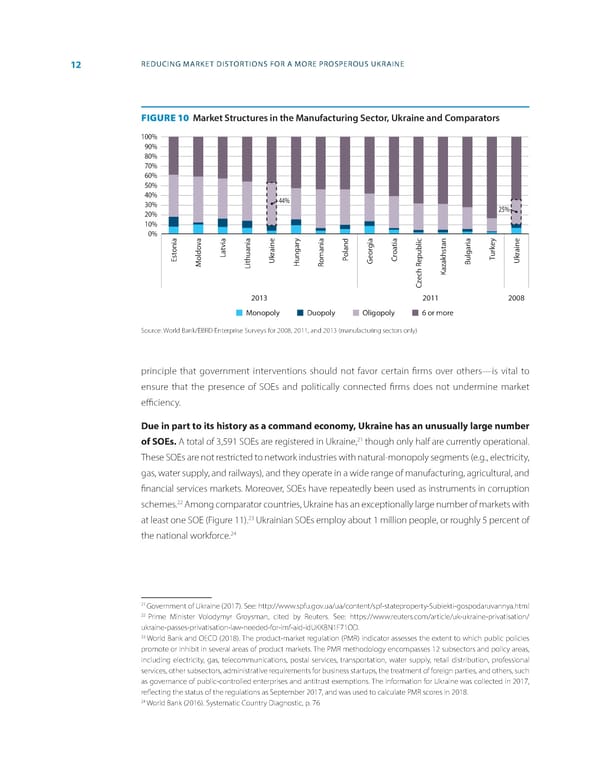
12 REDUCING MARKET DISTORTIONS FOR A MORE PROSPEROUS UKRAINE FIGURE 10 Market Structures in the Manufacturing Sector, Ukraine and Comparators 100% 90% 80% 70% 60% 50% 40% 44% 30% 25% 20% 10% 0% Estonia Latvia Ukraine Poland GeorgiaCroatia BulgariaTurkeyUkraine Moldova Lithuania HungaryRomania Kazakhstan Czech Republic 2013 2011 2008 Monopoly Duopoly Oligopoly 6 or more Source: World Bank/EBRD Enterprise Surveys for 2008, 2011, and 2013 (manufacturing sectors only) principle that government interventions should not favor certain 昀椀rms over others—is vital to ensure that the presence of SOEs and politically connected 昀椀rms does not undermine market e昀케ciency. Due in part to its history as a command economy, Ukraine has an unusually large number 21 of SOEs. A total of 3,591 SOEs are registered in Ukraine, though only half are currently operational. These SOEs are not restricted to network industries with natural-monopoly segments (e.g., electricity, gas, water supply, and railways), and they operate in a wide range of manufacturing, agricultural, and 昀椀nancial services markets. Moreover, SOEs have repeatedly been used as instruments in corruption 22 schemes. Among comparator countries, Ukraine has an exceptionally large number of markets with 23 at least one SOE (Figure 11). Ukrainian SOEs employ about 1 million people, or roughly 5 percent of 24 the national workforce. 21 Government of Ukraine (2017). See: http://www.spfu.gov.ua/ua/content/spf-stateproperty-Subiekti-gospodaruvannya.html 22 Prime Minister Volodymyr Groysman, cited by Reuters. See: https://www.reuters.com/article/uk-ukraine-privatisation/ ukraine-passes-privatisation-law-needed-for-imf-aid-idUKKBN1F71OD. 23 World Bank and OECD (2018). The product-market regulation (PMR) indicator assesses the extent to which public policies promote or inhibit in several areas of product markets. The PMR methodology encompasses 12 subsectors and policy areas, including electricity, gas, telecommunications, postal services, transportation, water supply, retail distribution, professional services, other subsectors, administrative requirements for business startups, the treatment of foreign parties, and others, such as governance of public-controlled enterprises and antitrust exemptions. The information for Ukraine was collected in 2017, re昀氀ecting the status of the regulations as September 2017, and was used to calculate PMR scores in 2018. 24 World Bank (2016). Systematic Country Diagnostic, p. 76
 World Bank Document Page 19 Page 21