
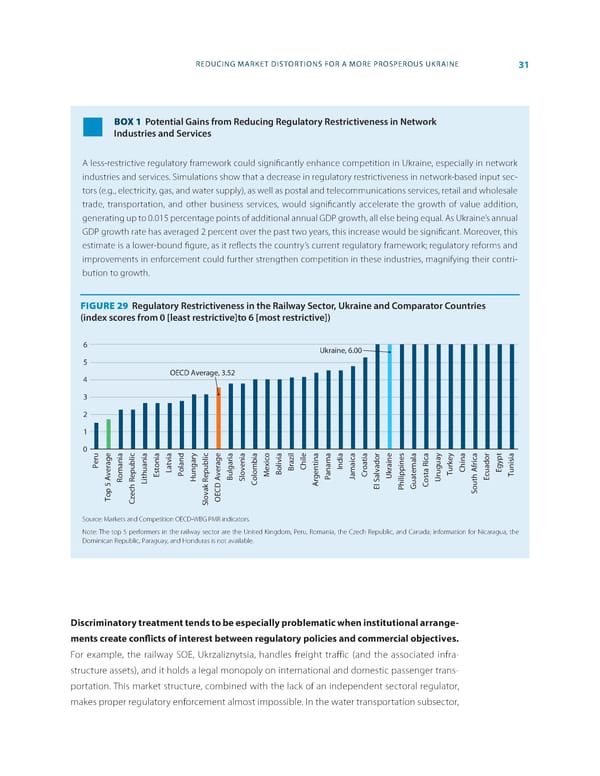
REDUCING MARKET DISTORTIONS FOR A MORE PROSPEROUS UKRAINE 31 BOX 1 Potential Gains from Reducing Regulatory Restrictiveness in Network Industries and Services n A less-restrictive regulatory framework could signi昀椀cantly enhance competition in Ukraine, especially in network industries and services. Simulations show that a decrease in regulatory restrictiveness in network-based input sec- tors (e.g., electricity, gas, and water supply), as well as postal and telecommunications services, retail and wholesale trade, transportation, and other business services, would signi昀椀cantly accelerate the growth of value addition, generating up to 0.015 percentage points of additional annual GDP growth, all else being equal. As Ukraine’s annual GDP growth rate has averaged 2 percent over the past two years, this increase would be signi昀椀cant. Moreover, this estimate is a lower-bound 昀椀gure, as it re昀氀ects the country’s current regulatory framework; regulatory reforms and improvements in enforcement could further strengthen competition in these industries, magnifying their contri- bution to growth. FIGURE 29 Regulatory Restrictiveness in the Railway Sector, Ukraine and Comparator Countries (index scores from 0 [least restrictive]to 6 [most restrictive]) 6 Ukraine, 6.00 5 4 OECD Average, 3.52 3 2 1 0 u e c d y c e e a a r e s y y r t a r ia i ia ia r i ia iaia zill ia ia o e la o p i g l n l g r i n icat n ca a e ica e n n a b viaa m d i a i ina y is a b tviaa b a a i h ti a d n u k r P r a an o l g r en xicolr a n a i R r h f n u u a u g v m e o B C n I oa a r p m u adg e m st L o n e l n m r v e a C A u E u v p h P p v u lo B e a l p t ug T c o t E u e lo M g a C a Uk i st r h T A i A B S o P J l a t E R Re H r S i o U 5 L k RD C A l h u C u h a E P G o p c v C S o e E T Cz loO S Source: Markets and Competition OECD-WBG PMR indicators. Note: The top 5 performers in the railway sector are the United Kingdom, Peru, Romania, the Czech Republic, and Canada; information for Nicaragua, the Dominican Republic, Paraguay, and Honduras is not available. Discriminatory treatment tends to be especially problematic when institutional arrange- ments create con昀氀icts of interest between regulatory policies and commercial objectives. For example, the railway SOE, Ukrzaliznytsia, handles freight traffic (and the associated infra- structure assets), and it holds a legal monopoly on international and domestic passenger trans- portation. This market structure, combined with the lack of an independent sectoral regulator, makes proper regulatory enforcement almost impossible. In the water transportation subsector,
 World Bank Document Page 38 Page 40